Cape Town dam levels increase to 96,4%
15 September 2020
The total capacity of dams supplying the Cape Town metro increased to 96,4% between 7 September and 13 September 2020, a 0,8% rise from the previous week. Water consumption for the same period decreased by seven million litres per day from an average of 654 million litres per day the previous week to 647 million litres per day. At the same time last year, dam levels were at 81,9%. The increasing dam levels over recent weeks, due to rainfall coupled with the decrease in water demand, has generated questions from residents about water tariffs.
In summary:
Tariffs are currently on Level 1 and are much lower than during the peak of the drought.
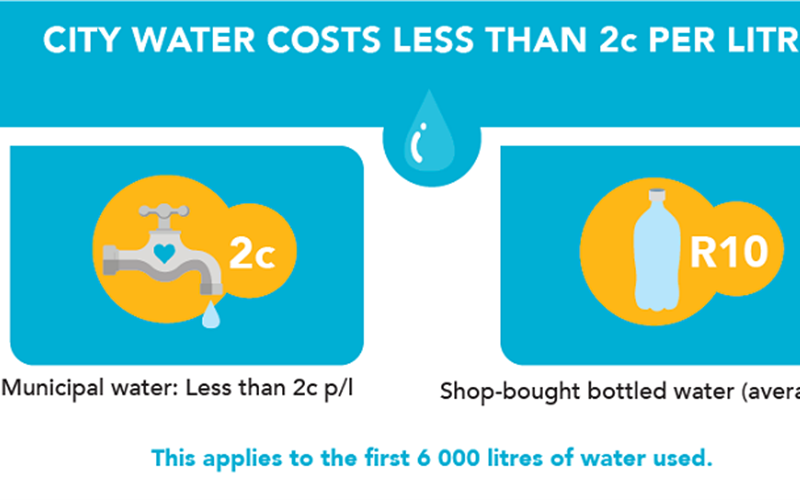
On Level 1 tariffs, the second lowest tariff level, residents pay less than 2 cents per litre of water in the first step of the tariff (i.e. for the first 6 000 litres used) versus an average of R10 for a litre of bottled shop water.
The City will need to consider whether to move to the lowest tariff, being the no-restriction, water-wise tariff, over the coming months. Importantly, that decision is based on how much water is likely to be sold so that water services can still be paid for, rather than how much water is in the dams.
The fixed basic charge is not an ‘additional’, ‘temporary’ or ‘penalty’ charge. It forms part of the total water tariff, which covers the cost of providing and maintaining a reliable water service. It also contributes to our augmentation projects to increase the resilience of our water supply to future climatic shocks by diversifying our water sources, and not largely rely on surface water, such as dams.
Residents who are registered as indigent are exempt from paying the fixed basic charge portion of the water tariff and continue to receive an allocation of free water.
The City does not budget for profit/surplus from the sale of water and seeks to keep costs of service delivery as low as possible.
The City’s tariff increases for 2020/2021 financial year were among the lowest in the country.
‘Seeing the dam levels draw nearer and nearer to the 100% mark is exciting because this has been the fullest they have been since 2014. Many have been keeping a close eye on the dam levels, which have reached 96,4% due to rainfall and the decrease in water demand.
‘The City will be reviewing the status of dam and water restriction levels following the conclusion of the hydrological year (end October) in terms of planning and making projections, which is a standard, annual process. This is done in consultation with the National Department of Water and Sanitation, and other major water users in the catchment, such as the other municipalities and irrigation boards, who all depend on the same water source.
‘The City is currently on Level 1 tariffs, which is the second lowest tariff level and it will need to consider whether to move to the lowest tariff, being the no restriction, water-wise tariff. The lowest tariff is not tied to a restriction level. Importantly, that decision is based on how much water is likely to be sold so that water services can still be paid for, rather than how much water is in the dams. Thus the decision on a possible change to the restriction level needs to take place first.
‘In addition to the welcomed rainfall, we want to thank residents and businesses for using water responsibly as well as for paying their water accounts, which contributes to providing and maintaining a sustainable, reliable water service for all,’ said Alderman Xanthea Limberg, the City’s Mayoral Committee Member for Water and Waste.
The water tariff (which includes a usage portion and a fixed charge) covers the cost of purchasing the bulk water, the treatment of the water, the delivery of the water to homes and businesses and the maintenance of all the infrastructure to deliver this service. Sewage also needs to travel from households, commercial and industrial properties, to wastewater processing facilities for treatment.
The infrastructure includes:
11 500 km water network
9 500 km sewer network
5 600 km stormwater network
490 waste water pump stations and
23 waste water treatment works, among other assets
The cost of maintaining these remain largely the same regardless of how much water passes through them, how much or little water is used, or how much water is in the National Department of Water and Sanitation’s dams that supply Cape Town, agriculture and the other municipalities.
In the most recent independent cost of living surveys done, Cape Town’s basic services costs were again shown to be the lowest when compared to other cities in the country.
For more information on new water sources, water restrictions (Level 1 currently in place), guidelines around alternative water sources such as boreholes and rainwater tanks, as well as tariff information, please visit www.capetown.gov.za/thinkwater
More information about the City’s Water Strategy can be found here: https://www.capetown.gov.za/general/cape-town-water-strategy
Frequently asked questions and answers with Alderman Xanthea Limberg:
1. Now that the dam levels are increasing, can the City reduce the water tariffs?
The City does not budget for a profit from the sale of water and seeks to keep costs of service delivery as low as possible. The fixed/variable tariff model that the City uses is in place throughout South African municipalities due to the increased water security it allows.
A reduction in tariffs will be dependent on an increase in consumption. While the dams are the fullest they have been since 2014, consumption is still significantly lower than before. Currently, the City is selling approximately 30% less water than before the drought, but is facing additional costs that come with increasing our resilience through additional water resources. It is important that the City covers its costs to ensure that the maintenance and augmentation programmes can be carried out. Should the amount of water we are selling significantly increase, this will be factored into the tariffs, but given the uncertain impact of climate change, it may not be wise to actively encourage such an approach at this stage.
The City is currently on Level 1 tariffs, which is the second lowest tariff level and it will need to consider whether to move to the lowest tariff, being the no restriction, water-wise tariff. The lowest tariff is not tied to a restriction level. Importantly, that decision is based on how much water is likely to be sold so that water services can still be paid for, rather than how much water is in the dams. Thus the decision on a possible change to the restriction level needs to take place first.
2. What is the fixed charge and why do we need to pay a fixed basic charge when the dam levels are increasing?
Please note:
The fixed basic charge is not a ‘drought levy’. A proposed ‘drought levy’ was considered at one point during the drought, but it was never approved and therefore not implemented.
The fixed basic charge is not ‘an additional tariff’ but it forms part of the total water tariff structure.
The total water tariff (which includes a usage portion and a fixed charge) covers the cost of purchasing the bulk water, the treatment of the water, the delivery of the water to homes and businesses and the maintenance of all the infrastructure to deliver this service.
The fixed basic charge portion of the tariff was introduced to ensure financial sustainability to provide the service irrespective of the level of consumption and to ensure a fairer payment of the costs by all customers.
Prior to the drought, the tariff was based on a consumptive portion only. The drought revealed that if consumption dropped significantly (i.e. beyond levels we could have expected before the drought), it could also affect our long-term future by taking away resources for necessary maintenance of the water service.
As such, the City changed the tariff structure so that a fixed portion of the revenue necessary to run the system responsibly is guaranteed no matter how much water residents consume. This is a funding model that is used at all South African municipalities.
The consumptive tariff portion is lower than it would be if there was no fixed portion.
3. Do other municipalities have fixed charges?
Yes, this fixed/variable tariff model is in place throughout South African municipalities to guarantee a fixed and stable income to fund the water service as it increases water security.
4. Why don’t we get 6kl free water per month per household anymore?
The free 6Kl of water per month for every household across the board was largely made possible by properties consuming high volumes of water, in the upper steps of the tariff which are no longer available. It was neither possible nor sustainable to continue delivering 6Kl of potable (drinking) water at no cost to every household in the city.
Residents who are registered as indigent continue to receive an allocation of free water.
End
Published by:
City of Cape Town, Media Office